

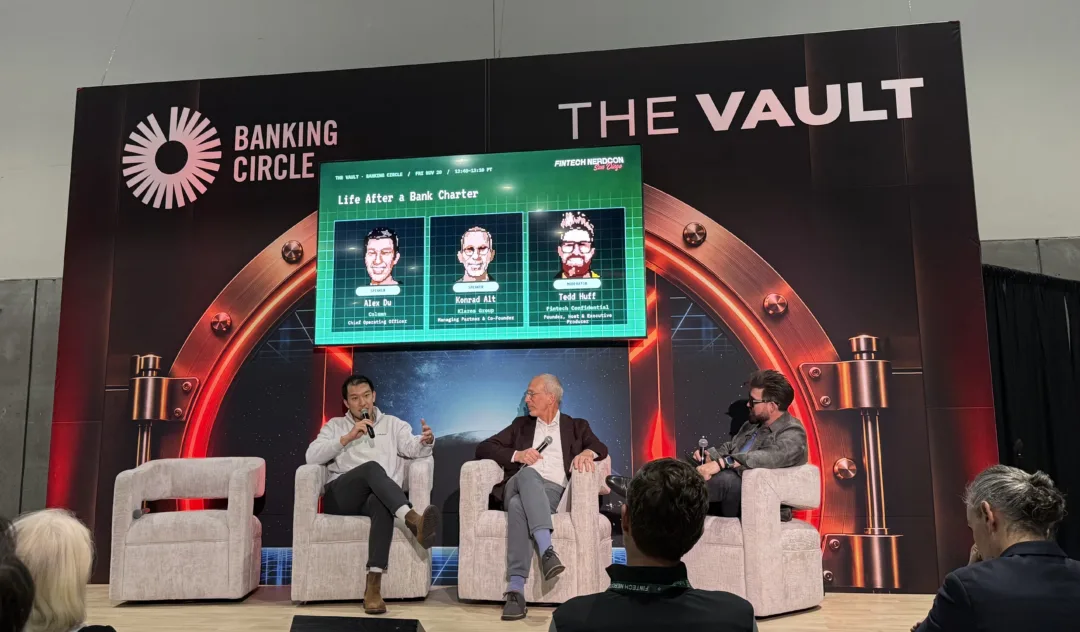
At Fintech NerdCon in San Diego on Nov. 19 and 20, speakers kept coming back to what it costs to scale a fintech.
Column's chief operating officer said its bank charter has likely cost more than $200 million over seven years, and Alpaca's CEO called customer acquisition in prediction markets very expensive. Compliance leaders described how to keep up with that growth without adding friction for customers.
Gregory was the official PR partner for Fintech NerdCon, which brings together fintech founders, investors, executives, and industry leaders to talk about the issues shaping financial services. Kyle W. Kempf, senior vice president and head of fintech at Gregory, also hosted the Office Hours Fintech PR Clinic, talking with founders and industry leaders about storytelling and building visibility in fintech.
Getting a bank charter is a long-term commitment
Deciding to pursue a bank charter is like "getting a face tattoo," according to Alex Du, chief operating officer of Column. You have to be really confident it's the right decision.
During the "Life After a Bank Charter" panel, Du said getting and operating its own charter has likely cost Column more than $200 million over the past seven years. A charter also means repeatedly raising equity, with each raise bringing dilution.
Du also argued that big tech wallet products and banks that hired coders have struggled in financial services for the same reason: One side of the business dominated. Successful financial institutions need engineering, product, and design to have a seat at the table alongside legal, risk, and compliance. They also need processes that allow teams to move quickly without compromising regulatory obligations. Top compliance talent costs as much as top engineering talent, Du noted, and a discount version of compliance doesn't work.
Konrad Alt, co-founder and managing partner of Klaros Group and a former Senior Deputy Comptroller of the Currency, said banking success is measured in generations. Alt also noted that some fintech founders struggle to adapt to their relationships with bank examiners. His reminder: An examination is not a negotiation.
For a chartered fintech, the story matters as much as the license. Regulators, investors, and customers will hold the company to what it says for years, so the narrative has to hold up well past the launch announcement.
Prediction markets have demand ahead of infrastructure
Brokerage platforms and investors want prediction markets, but the infrastructure and economics to support them are still developing.
During the "Prediction Markets: Financial Infrastructure or Nationalised Betting?" panel, Yoshi Yokokawa, co-founder and CEO of brokerage infrastructure company Alpaca, said roughly 350 of the company's partners worldwide want to offer prediction markets. Many are Robinhood-style brokers facing margin pressure while companies such as Kalshi and Polymarket bring in large revenues and command high valuations.
The infrastructure to support these products isn't fully built. Alpaca plans to help bridge that gap by connecting Kalshi's products with its partners' broker-dealers.
Yokokawa also expects greater clarity around U.S. prediction market regulation to have implications abroad, with the answer differing by region. He expects the answer to be mostly no in the Middle East, likely fine in some Asian countries, and subject to its own nuances in Europe.
The market's rapid growth is also bringing greater scrutiny. Rob Hadick, general partner at Dragonfly, pointed to two prediction-market businesses that went from zero revenue a year ago to roughly $6 billion and $2 billion in annualized revenue, respectively. At that scale, legal and regulatory risks grow much larger.
Customer acquisition is another hurdle. Yokokawa described it as very expensive, with the market leaders spending heavily on marketing. Alpaca's partners want to cross-sell prediction markets alongside their existing products, potentially making it difficult for standalone prediction-market businesses to compete. That pressure could grow if funding gets more expensive and interest rates rise.
Howard Lindzon, founder of Stocktwits, sees an opening for social platforms. Prediction markets give them their first revenue model beyond advertising that doesn't require setting up a broker-dealer. But moderator Petrit Berisha of Brainfood repeatedly asked the question every social prediction-market pitch has to answer: Who will drive volume?
In 2027, Hadick will watch institutional uses such as equity KPIs, private company valuations, and parametric insurance. If these markets take off, their volume could dwarf sports betting. A court ruling on sports contracts could also affect profitability.
Berisha's question is about distribution, and distribution depends on the story a company tells. A company entering this market has to explain why users will trade on its platform instead of with the leaders already spending heavily to reach them.
Compliance programs should scale with risk
Compliance programs have to grow with the company without adding friction for customers or slowing the business.
At "The Compliance Leader's Playbook: Scaling Trust Without Slowing Growth," Jim Prevot, managing director of StrategyBRIX, identified a common onboarding mistake: using one process that asks every customer for every document. Instead, Prevot recommended tiering onboarding requirements by risk. Start with database verification and request additional documentation only when a risk trigger warrants it.
Henry Chan, chief compliance officer at Cybrid, said his team rebuilt its onboarding process around this approach and cleared a backlog of investigative cases.
Chithra Ramachandran of Zolve described a different way to strengthen compliance oversight. Her program moved from sampling to testing 100% of the population, supported by daily control reports. Partner banks welcomed the change.
One measure of compliance effectiveness that came up in the discussion: how quickly a regulatory change or emerging risk can be translated into an effective control. A clean compliance report isn't necessarily evidence that everything is working. It may mean the testing process isn't identifying failures.
AI and automation are changing the pace of compliance
During "Building Payments Compliance on Social Media Platforms," Rob DeCampos, chief compliance officer and head of payments compliance at X, said the fundamental compliance challenges are similar at banks and fintechs. The difference is speed.
Drawing on experience at American Express, PayPal, Intuit, Western Union, and JPMorgan, DeCampos described his approach to working with product and engineering teams: He doesn't tell them no. He says "not yet," works with them to understand the problem, and finds another way to get it done. He cited one deployment that went live in five hours instead of five months.
DeCampos also offered a prediction about AI's role in financial crime compliance. Asked whether AI will write most suspicious activity reports (SARs) within three years, he predicted it would happen within a year. He also expects an AI agent to eventually be named as the author of a SAR.
In our view, trust is something a fintech can show in how fast and how carefully it ships. Tiered onboarding, full-population testing, and a deployment measured in hours give a company concrete proof to point to when it talks about trust.
Fintech NerdCon brought together a thoughtful mix of founders, investors, operators, and industry experts who are shaping the future of financial services. The conversations went beyond the latest trends to examine the practical challenges and opportunities facing companies as they grow. We appreciated the opportunity to be part of the event as its official PR partner and to connect with so many people who are building what comes next in fintech. Congratulations to the founders and the entire Fintech NerdCon team on another terrific gathering.