

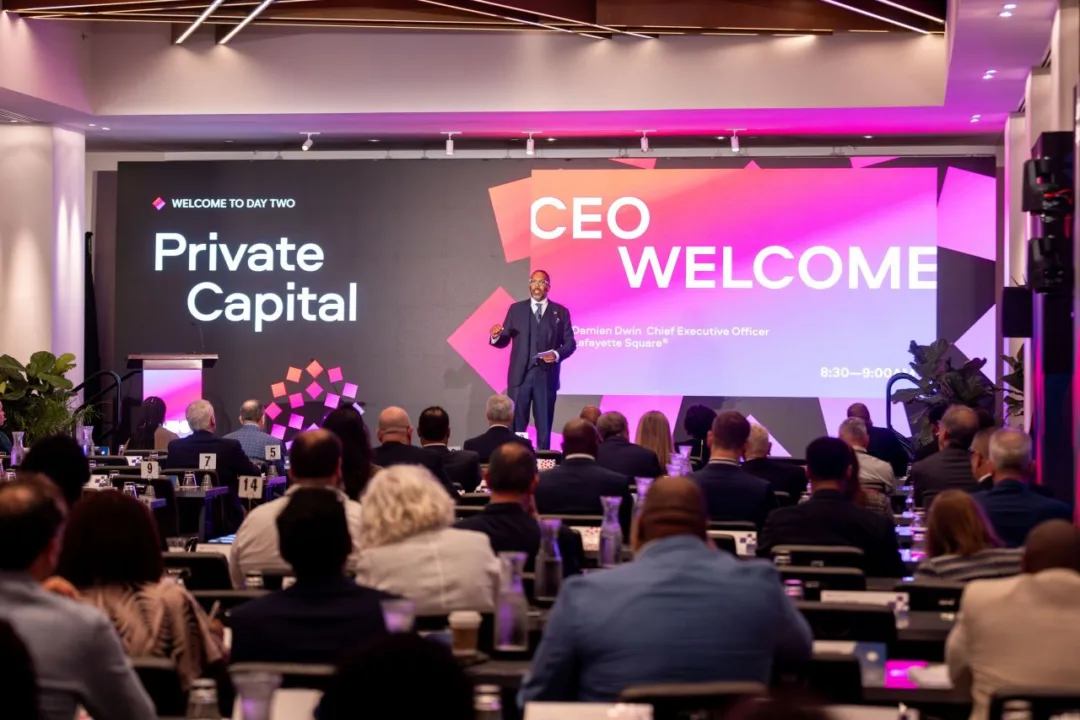
There are plenty of industry conferences focused on AI, private capital and the future of work. What stood out at OUTCOME2030 in Washington, D.C. last month was how often the discussions returned to working-class communities that are typically left out of mainstream economic conversations.
Over three days, Lafayette Square Technologies, a place-based data analytics platform, Lafayette Square USA, Inc., a private investment platform focused on economic mobility and working-class communities, and Worker Solutions®, an employee services platform, brought together investors, economists, policymakers, business leaders, workforce innovators and technologists to explore how capital, technology and workplace benefits can actually improve economic mobility for working-class communities. Where most industry events focus on transactions, fundraising or market outlooks, the conversation here kept coming back to something bigger.
At the center of those conversations was Goal2030™, Lafayette Square's public commitment to support 100,000 working-class jobs, invest 50% of capital in working-class places, and implement new benefits for 50% of its portfolio companies by 2030, with progress tracked and reported annually. Recurring themes at the conference were framed as tangible levers for expanding opportunity and creating results that Lafayette Square, Lafayette Square Technologies, and Worker Solutions® will measure and revisit at OUTCOME2030 each year.
AI, Capital and Workforce Participation Are Converging
AI was one of the defining themes of the conference, but the discussions rarely centered on fear, replacement headlines or futuristic speculation. Instead, speakers talked about AI as a tool to help identify workforce gaps, improve access to financial services, better understand local economic conditions, and support smarter investment and hiring decisions for employers, lenders and communities.
Some conversations focused on how regional labor-market intelligence can help businesses make more informed decisions around hiring, training, retention and growth. Others explored how technology can improve access to financial products and employee benefits for people who have historically been underserved by traditional systems.
AI conversations are often crowded with noise, but the strongest narratives come from organizations that can explain how technology connects to people's daily lives, financial stability, healthcare access and long-term opportunity. OUTCOME2030 consistently brought the discussions back to those themes. Harvard University's Raj Chetty provided broader economic context through data on social capital and mobility trends, while Tulsa Mayor Monroe Nichols spoke to how local leadership and place-based investment shape long-term outcomes for communities.
Conversations around the newly signed Investing in All of America Act added even more relevance, particularly as policymakers and investors continue looking for ways to expand capital toward underserved businesses, manufacturers and regions outside traditional investment hubs.
As communicators, one of the most interesting aspects of the event for us was how naturally the policy, finance and workforce conversations intersected. Usually, those are separate media narratives with different audiences attached to them. OUTCOME2030 created a framework where those conversations could overlap, presenting the rare communications challenge where the answer was not choosing one audience, but recognizing how relevant the story felt across financial trades, policy reporting, business media and economic storytelling.
Economic Mobility Is Becoming a Business Conversation
Across sessions, employee benefits were framed less as a standalone HR issue and more as part of how companies think about productivity, retention, hiring challenges and enterprise value. Speakers discussed emergency savings tools, healthcare affordability, workforce retention and employee financial stability in a way that tied directly back to business performance.
Day 3 sessions hosted by Worker Solutions®, a Lafayette Square USA, Inc. portfolio company, framed workforce support as operational infrastructure for employers rather than an optional add-on, exactly the kind of portfolio-wide, measurable improvement that Goal2030™ is designed to track. Speakers continuously returned to the idea that hiring stability, employee retention and financial well-being increasingly affect operational resilience, particularly for middle-market employers navigating labor shortages, rising costs, and growing pressure to retain workers in competitive markets.
Why the Story Resonates
One of the biggest takeaways from OUTCOME2030 was how meaningful and integrated Lafayette Square’s approach feels. With Goal2030™ tied to annual public reporting, the story has a horizon and a reason to return.
The conversations around AI, private capital, workforce participation, employee benefits and economic mobility all connected back to the same broader mission around expanding opportunity in working-class communities. That consistency and the accountability built around it gave the event a sense of purpose that can sometimes be difficult to find at large industry conferences.
The most effective financial services stories today are rarely just about products or performance. The strongest stories connect investment strategies and capital markets activity to real-world outcomes and show how firms are responding to economic shifts that affect businesses, workers, families and communities simultaneously.
As storytellers, the event reminded us that some of the most compelling stories in financial services are no longer confined to mainstream or institutional conversations. It was encouraging to see OUTCOME2030 bring conversations around technology, labor, policy, healthcare access and economic opportunity into the same room, while keeping the focus on the people most affected by those forces.