


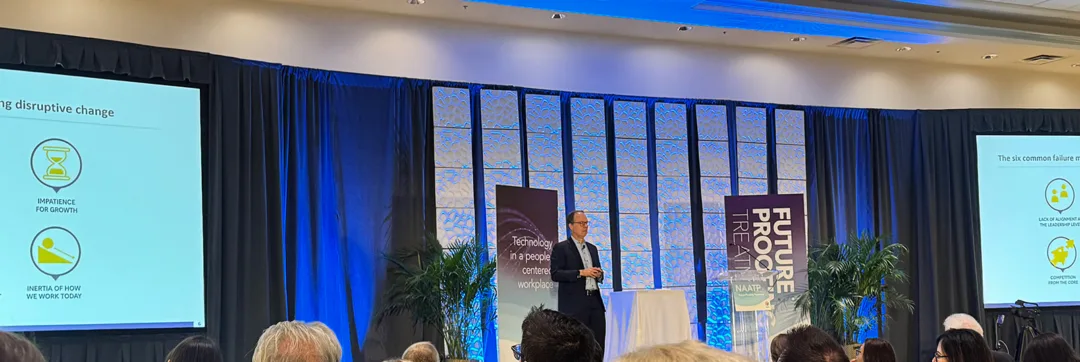
More than 500 addiction treatment executives recently gathered on Amelia Island for NAATP National 2026, the association's 47th Annual Addiction Treatment Leadership Conference. The theme was Future-Proofing Treatment: Technology in a People-Centered Workplace, and the conversations in the sessions, addresses and dinners reflected it. This is a field that has stopped debating whether change is coming and started grappling with what to do about it. For communications professionals in behavioral health, that shift holds particular importance. The organizations asking the right operational questions are often the same ones struggling to tell a coherent story externally, and the gap between what providers are doing and what they are communicating has rarely been more consequential.
Organizations That Will Lead Are Planning Five Years Out
The opening keynote challenged attendees to stop operating in "present-forward" mode, taking what exists today, extrapolating it forward, and calling it a plan, and start thinking "future-back": defining where you want to be in three to five years and working backward from there. The argument was pointed. Generative AI is moving to mainstream adoption faster than any prior technology shift, and behavioral health providers in a wait-and-see posture will find themselves reactive in a conversation that has already moved.
The impact on communications is direct. Organizations that can articulate a forward-looking point of view on where they are headed will have a meaningful advantage with reporters, policymakers, and referral partners. Those struggling are often not lacking in vision internally. They are lacking the infrastructure to express it, and that gap is increasingly costly.
The GLP-1 Conversation Has Shifted from Speculation and Skepticism to Evidence
GLP-1 receptor agonists were among the most discussed topics on the floor, and the conversation has moved meaningfully in the past year. Early research shows real results with significant reductions in cravings among patients with opioid use disorder, and the clinical community is paying close attention. For providers doing this work, now is the moment to be telling that story. Most are not yet integrating GLP-1 medications or are not talking about it publicly. The clinical conversation is ahead of the communications one, giving real opportunity for organizations that move first to establish credibility and own the narrative before the space becomes crowded.
AI Adoption Is a People Problem, Not a Technology Problem
Every AI conversation at NAATP eventually arrived at the same conclusion. The technology is not the hard part. Getting a workforce that is already stretched and skeptical to trust it is. Organizations that are successfully operationalizing AI are doing so because their leadership has been upfront about what the tools are for, what they aren’t for and what guardrails are in place, naming the anxiety directly rather than asking people to adopt new systems while pretending the discomfort does not exist.
For providers looking to get ahead of this narrative, the internal communications work has to come first. Journalists, regulators, and community partners will eventually ask what AI is doing in your organization, who oversees it, and most importantly, how it protects patients. The organizations already answering those questions internally will be far better positioned to answer them publicly.
The Stories That Build Lasting Credibility Are Personal
Some of the conference's most resonant moments came not from technology panels but from leaders speaking plainly about the human cost of the work. Succession planning, leadership transition, and the emotional weight of running a behavioral health organization were threaded through multiple sessions, and the speakers who resonated were the ones willing to be open and honest about failure and timing, not just outcomes and metrics.
This tracks with what we see in media. Reporters covering behavioral health are not short on data. They are short on leaders willing to speak candidly about what this work actually takes, where they are and where they are headed. The thought leadership that builds lasting credibility in this space is not always about what an organization has achieved. It is about what leaders have learned, what it cost them, and what they would tell someone a decade behind where they are now.
What This Means for Communicators in Behavioral Health
The providers that emerge from this period with the strongest reputations will be the ones that got ahead of the narrative on AI, told their GLP-1 stories before someone else defined them, and were willing to let their leaders speak honestly about what this work demands. The clinical innovation is real and the field has no shortage of stories worth telling -- all of which NAATP showed us. The question is whether organizations are telling them.