
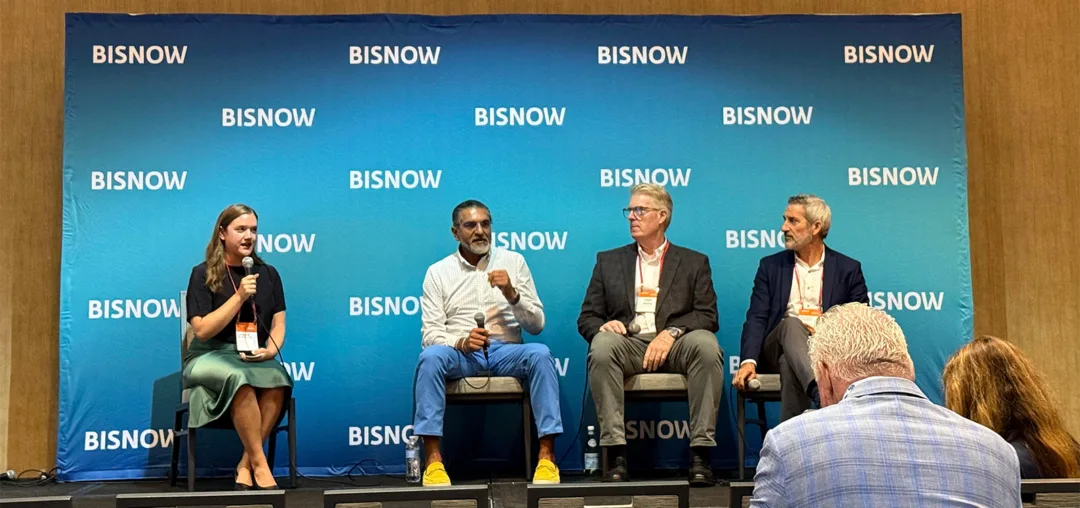
I spent a day at Bisnow's National Data Center Power, Energy & Sustainability Conference in Philadelphia, and closed it out moderating a panel on water reuse, battery storage, and the sustainability side of data center infrastructure. Every panel was insightful, but one theme really stuck out to me throughout the day: community education and conversation are key to building trust in data centers.
It's worth remembering that data centers aren't new. In fact, the first one was built in 1945. What's new is the scrutiny. A recent Gallup poll found that seven in 10 Americans don't want an AI data center built where they live. So the industry has decades of engineering behind it but a serious trust problem in front of it, and that tension shaped nearly everything discussed in Philadelphia.
A few things from the day stuck with me.
The contract that matters the most isn’t the one with the utility
On my panel, Chris Ruppel of Keel Infrastructure said something that really stayed with me since. Every community asks a developer the same three questions: whether their power bill is going up, whether their water supply is affected, and what they actually get in return. His point was that the agreement a developer makes with the people living nearby is the most important deal of the project. That reframes the whole development conversation as a relationship, not a checklist.
Data centers should come with a nutrition label
Nabeel Mahmood, of the Nomad Futurist Foundation, made the case that the industry earned its bad reputation the hard way through decades of windowless buildings with no signage and zero effort to explain what was happening inside. His suggested solution was concrete: give every facility a ‘nutrition label:’ a simple, standardized public disclosure on water use, power draw, and community impact, so the numbers are out before a headline has to fill in the blank. As he put it, trust isn't an engineering spec, it's earned. And it only gets earned when marketing, policy, and engineering are in the same room from the start rather than passing the project down the line.
Being flexible with the grid is starting to pay
Another takeaway from my panel was from Michael Mindell of CPower Energy Management who spoke about grid flexibility. Simply put, “you’re either going to be forced to do it or you’re going to be compensated to do it.” He mentioned PJM (the largest grid operator in the United States) is currently paying $122,000 per megawatt for load taken off the grid during peak periods. Battery storage is becoming a key asset, and the operators are starting to treat that flexibility as a revenue line instead of a backup plan.
The path forward
Sessions earlier in the day, covering procurement, backup power, and regulation, with impressive experts from all across the industry, kept the room engaged and inspired all day. The topics on the agenda might have been interconnection queues, resilience, or future development, but the real conversation was always about earning a yes from the people next door.
The data center industry has 80 years of engineering behind it. What it's still building is the framework for explaining itself, plainly and early, to the people who'll be living near the next facility. Philadelphia felt like a room full of people who already know that. The trick now is to have conversations, start them early, and continue them.