

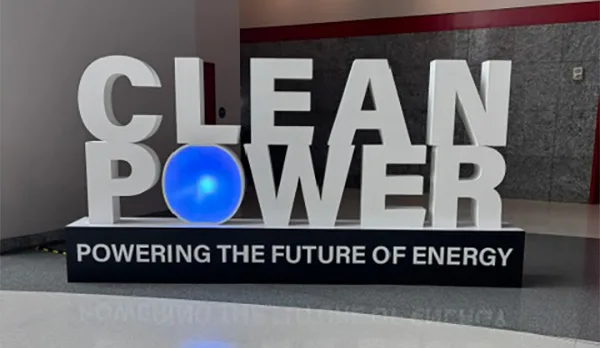
Every year, CLEANPOWER brings together clean energy companies, experts, corporate leaders, and policy makers all under one roof. This year in Houston, the conference drew 8,000-plus attendees and more than 500 exhibitors across wind, solar, storage, transmission, and everything in between.
Our team spent most of our time on the exhibitor floor, having conversations with those who see where the industry’s headed day in and day out. While walking the floor, a couple things stood out to us that have significant implications for how clean energy companies communicate their stories right now.
The Decommissioning Wave Is Coming
One of the more striking patterns this year was a noticeable uptick in exhibitors specializing in renewable project decommissioning, such as wind turbine teardowns, solar field removal, and solar panel recycling. A niche market that once seemed like a distant concern is about to become more important than ever.
The reason isn't hard to figure out. A significant ramp up of utility-scale wind and solar deployments in the U.S. took place in the late 2000s and early 2010s and with twenty-year project lifespans as the norm, a lot of those assets are quickly approaching end-of-life. That volume is only going to accelerate. Right now it's a trickle, but within a few years, project retirements will come flooding in.
For decommissioning contractors, recyclers, logistics firms, environmental consultants, and others in this space, this turning point represents a significant opportunity. And it's a story that has yet to make big waves in mainstream media.
So what does that mean for communications professionals in the clean energy industry? Reporters covering clean energy have spent years writing the "build" story. The installation milestones, the project announcements, the capacity records, and the programs and incentives pushing it all forward. While the media has increased focuse on the "end of life" chapter, or what comes next, it’s still mostly unwritten. There's a lot of runway for companies in this segment to establish themselves as credible voices in the conversation before it becomes crowded.
Whether you do public relations for a decommissioning company or the developer whose project will eventually be taken down, this is the moment to get ahead of the narrative. What does responsible decommissioning look like? How does panel recycling scale? What are the supply chain implications? For developers or project owners, things like proactively communicating their decommissioning plans or responsible end-of-life practices, and showing that they've chosen partners committed to proper recycling and disposal will be key.
These are legitimate policy, environmental, and business stories, and the companies that fare best will be the ones telling them proactively rather than waiting to respond when questions arise.
Data Centers Have Become Ingrained into the Clean Energy Ecosystem
As we spoke to more exhibitors and attendees, we noticed many companies that built their businesses on site selection, feasibility analysis, and energy infrastructure software for renewable projects had described a dramatic shift in their customer base. Data center developers and operators have adopted these tools in large numbers, often becoming the fastest-growing segment of their user base. One company told us data centers now account for roughly 60 percent of their users, showing just how readily these tools can adapt to meet new industry demand.
What's happening here is a convergence that was likely inevitable but is accelerating faster than most anticipated, largely driven by an increased demand for AI workloads. Services built to analyze land, grid access, permitting, and power availability for utility scale solar and wind farms turn out to be exactly the right tool for the job when you're trying to site a data center.
Unironically, we saw that a lot of these same tools helping to build critical AI infrastructure are also more frequently integrating AI into their services. Across site selection, project monitoring, interconnection queue navigation, etc., more and more companies are actively touting AI capabilities and agentic AI integration into their platforms and customer portals.
For clean energy companies, the data center surge represents a new revenue stream and a new audience — one with significant capital to deploy and a need for power. For the broader grid, it means demand is expanding faster than many projections anticipated, and that creates urgency around clean energy generation and the tools needed to optimize it.
For communicators working in this space, it’s no secret that the data center story is a hot topic. It's a story business media understands, technology reporters already cover, and energy reporters are actively incorporating into their beats. If your client's product or service touches data center power demand, even indirectly, there’s likely a timely story to be told. Now’s the time to be part of the conversation.
The Takeaway for Clean Energy Communicators
Trade show floors don't lie. What companies choose to exhibit and which categories are growing are signals that reflect where capital and attention are actually moving.
At CLEANPOWER 2026, two clear signals stood out: the end-of-life chapter of the renewables buildout is beginning, and the data center economy has become a structural part of the clean energy conversation.
For communications professionals and clean energy companies trying to figure out how to position themselves in this next chapter, both of these trends represent real opportunity before the narrative gets too crowded.