

Quick summary:
- AI search runs on user intent, not keywords, and brands that write clear, authoritative content aligned with what people actually ask will get cited more
- Brand voice and emotional subtext still matter because LLMs read positioning, sentiment, and values in your content, rewarding authentic storytelling over sterile optimization
- Citations alone won’t win in B2B. Deeper AI-driven research is creating new competitive comparisons where differentiated positioning determines who makes the shortlist
- The shift from traditional SEO to GEO gives communicators and PR professionals a measurable seat at the revenue table
Scroll through LinkedIn on any given day and you'll see SEO companies posting confidently about how to rank in AI search. It’s just SEO, they say. There are new buzzwords, but it’s the same playbook.
Leah Nurik says they're wrong.
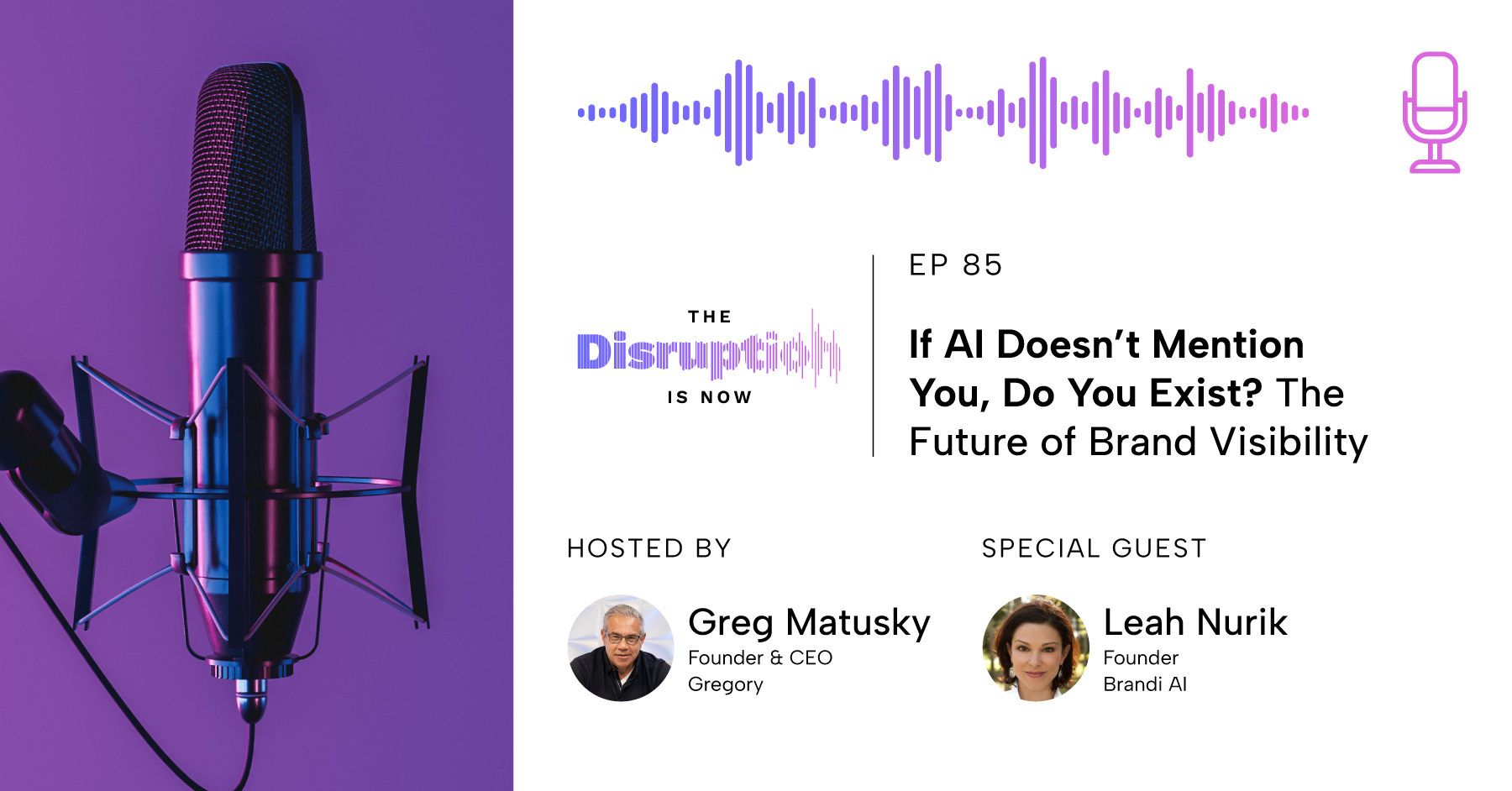
Nurik, co-founder and CEO of AI visibility and generative engine optimization (GEO) platform Brandi, sat down with host Greg Matusky on The Disruption Is Now to unpack how AI search works, why earned media and brand voice carry more weight than ever, and how communicators can use this moment to prove their value with real data.
Watch now:
Key takeaways:
AI search doesn’t care about your keywords
Traditional SEO was built on keywords. Stuff enough of the right terms into your content, build enough backlinks, and you could own the top of Google’s results page. That whole model is crumbling.
The large language models (LLMs) powering Google, ChatGPT, Perplexity, and Grok are trying to figure out who has the most authoritative, credible answer to a specific question and then summarize it. The days of hunting through 10 blue links are fading.
Nurik sees SEO professionals struggling with the transition. “What was your beautiful newborn baby is now your 12-year-old with zits,” she says. “It’s kind of hard to grasp that and to make the shift. But whether or not you want to do that, you’re going to have to get on the bandwagon or you’re going to be left behind.”
The shift means brands that answer the actual question a person is asking get rewarded. Write clear, readable, authoritative content structured around what your buyer persona actually wants to know, and the machine will find you, read you, summarize you, and return you as an answer.
Flowery marketing language gets you penalized
The LLMs don’t just read your words. They judge your tone. Overly promotional, self-congratulatory copy gets downgraded. Clear, direct language that genuinely addresses a customer’s pain gets elevated.
Nurik explains that brands will “get docked if it’s too marketing flowery.” But personality isn’t the problem. Being punny or playful doesn’t hurt. What hurts is language that tries to sell without actually saying anything useful.
Matusky discovered this firsthand. His firm’s website used to feature high-concept language about the breakdown of media and why PR had a new role to play. The machine didn’t care. Nobody writes a prompt asking for a PR agency that “understands the disintermediation of the media.” They ask for a PR agency with 130 employees that specializes in financial services. When he rewrote his site around direct, factual language in November, RFPs doubled.
The lesson applies across industries. The brands that match real language to real questions win.
Brand voice and subtext still get read by the machines
Nurik pushed back on the idea that AI search means dumbing everything down.
“All of that subtext in the content also gets read by the LLMs,” Nurik explains. “I hear a lot about people saying that creative will be replaced by AI. I don’t think so. I think that the creative will actually be elevated if they can be empowered to understand, to utilize AI.”
She uses a mouse analogy. Say you invent a mouse made from 100% sustainable materials that’s ergonomic, never runs out of battery, and connects via Bluetooth without pressing buttons. You can’t just write a blog post saying “this is the perfect mouse.” You need context, subtext, and emotional connection to the mission behind why you built it. The LLMs pick up on that depth.
Brandi’s platform includes a sentiment component that measures how brands are positioned across LLMs, tracking whether you get mentioned and how you’re perceived, what values the machine assigns to you, and whether your positioning is positive or negative. Getting cited is step one. How you’re framed in that citation determines whether it drives business.
AI search reveals market gaps your competitors haven’t filled
When Mallory looks at early AI adopters, two verticals stand out.
Financial services had massive compute requirements from trading analytics and customer modeling. Healthcare needed it for virology research and cancer treatments. Both had decades of data and existing infrastructure to build on.
"They really embraced it because they had those large compute requirements," Mallory explains.
Now the Fortune 1000 is catching up, applying AI to customer service, order quality, and response times. Even logistics companies use it to optimize truck routes for fuel economy and scheduling.
PR finally has KPIs that prove revenue impact
For decades, communicators sat in executive offices fielding the same question: What is this press release going to do to move revenue? The answer was always fuzzy.
AI search changes that equation. Nurik sees a world where PR professionals can deliver hard data to CMOs and C-level executives showing exactly how their brand appears in AI-generated responses, how they’re positioned against competitors, and whether the machine recommends them.
The opportunity goes beyond measurement. Nurik argues that PR is being elevated back to where it was before digital marketing pushed it down the organizational chart, potentially even surpassing traditional digital marketing in strategic importance. Brands that invest in content creation on their own domain, PR placements, syndicated content, and byline contributions get mentioned more in AI responses. That makes the work communicators have always done the engine that powers AI-driven brand discovery.
Key moments
- The difference between AI search and traditional SEO (04:11)
- Why each LLM returns different results and what that means for brands (08:13)
- What makes content authoritative in the eyes of AI (10:51)
- Why question-task alignment matters more than keyword density (13:15)
- The case for brand voice and emotional subtext in AI content (18:44)
- How LLMs assign sentiment and values to your brand (20:39)
- Why B2B deep-dive research through AI changes competitive positioning (23:44)
- PR’s opportunity to shine with AI search (28:39)
- Brandi's "market universe" concept for tracking brand positioning (30:30)
Q&A with Leah Nurik, co-founder and CEO of Brandi
Q: Do different LLMs behave differently for brand visibility?
A: The responses from Grok are so completely different. Grok tends to use and surface much more citations, and it has more brand mentions from what we see from the other platforms. Google doesn't break out its traditional search experience with Gemini, so we're not really sure what the breakdown is there. The only platform that isn't really built for AI search is Claude. It's built more for coders. Each platform has a different approach, and the results vary a lot.
Q: What is question-task alignment and why does it matter?
A: It's just like back in the day when you would write a good press release or a good paper for college. You'd say to yourself, what is the thesis statement? What am I trying to get across? What are the questions I'm trying to answer? And how do I connect authentically with the person who would either be reading it or asking those questions? Brands who invest heavily in content creation on their own domain or through PR, through syndicated content, byline contributions, will get mentioned more.
Q: What's the difference between getting cited by AI and actually shaping how AI defines your market?
A: Getting mentioned is step one. The bigger opportunity is shaping how the market itself gets defined. Say you're a wealth management firm that talks about a 360-degree lifecycle approach to financial planning. You should still talk about that. But you should also be thinking about whether that concept is becoming the standard the LLM uses to define the best approach in your category. Then you monitor whether the machine ties that definition back to your brand. That's where you go from being one of several citations to being the source that sets the terms of the conversation.