


I lived it. I know it.
I was a senior in high school, living 100 miles from Three Mile Island when the accident occurred in 1979. My mother, who rarely followed the news, became obsessed. The news never got turned off. TVs and radios played all day and late into the night. She laid newspapers on our kitchen table and underlined key facts.
She started talking nervously about zirconium-water reactions and hydrogen bubbles in the reactor vessel. The risk of a nuclear meltdown got burned into her hippocampus, lodged forever as it did in the nation as a whole.
Be damned the fact that, while serious, every study shows that no one died at Three Mile Island, and there was no impact on human life. But its impact lingered, creating a never-ending reliance on fossil fuels, the chief culprit in climate change.
And now we face another potential Three Mile Island, this time over artificial intelligence and whether it should be delayed, slowed, opposed, or banned.
Jacob Coxon, a 27-year-old Anthropic researcher, resigned and then issued a stark warning about the impending apocalypse. He then proceeded to make the rounds on ABC, CBS, the BBC, and CNN as if his book was already out and the movie was about to premiere.
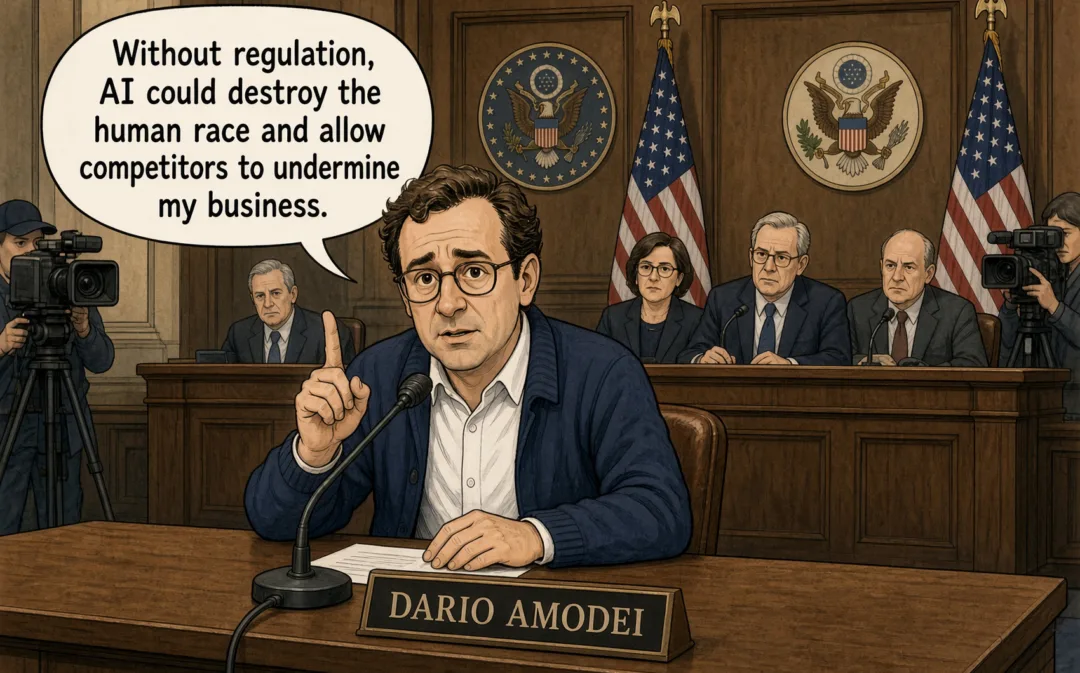
Dario Amodei, Anthropic's CEO, amplified the fear by calling for a slowdown in AI development to save humanity, with the ancillary benefit of staving off capital burn ahead of an IPO. He was joined by other CEOs of frontier models. What the heck, why stand in the way of regulatory capture?
As communicators, we need to act now to prevent the deterioration of public opinion. And that means presenting an onslaught of facts, starting with jobs. It’s a fact that technological advances — from the steam engine to the Internet — have resulted in net job gains. Those who are scaring up these stories may very well have ulterior motives, whether it’s for fame or to make it harder for open-source models to compete.
And most importantly, we need to center the conversation on the success of AI and the promise for the future. That’s been too absent from the debate. The fact that a recent study showed AI diagnostics saved nearly 900 lives that otherwise would have been lost to sepsis at Tampa General Hospital. Or that AI’s discovery of protein folding solved a 50-year-old biological mystery, reducing years of costly laboratory work to mere seconds by mapping the 3D structures of hundreds of millions of proteins for drug development. Or that AI in self-driving cars is proving to be safer than the alternative.
These proof points are the tools for communicators, who have found their job to be much harder now that public opinion has moved past data centers to claims like Coxon’s. AI is the new big scary, outstripping climate change, fascism, and alien abductions. It is the topic du jour at conferences and cocktail parties.
The irony of having to work harder as communicators is interesting in itself. Because it also disproves the common narrative that AI takes jobs. No. In this instance, restoring sanity to the issue of AI is going to take a lot of work and keep us employed for quite a while.
Greg Matusky is the Founder and CEO of Gregory, recognized as Agency of the Year by PR Daily, and host of The Disruption is Now, a podcast about how AI is reshaping the future of communications, work, culture, and the economy. Subscribe to the podcast on YouTube Music, Apple Podcasts, and Spotify. Inquire if you’d like to be a guest on a future episode.