


Ninety-four percent of B2B buyers now use AI somewhere in their purchasing journey. Fifty-five percent turn to it specifically when evaluating fintech vendors, and forty-seven percent say the tool is actively shaping their internal buying process, not just informing it.
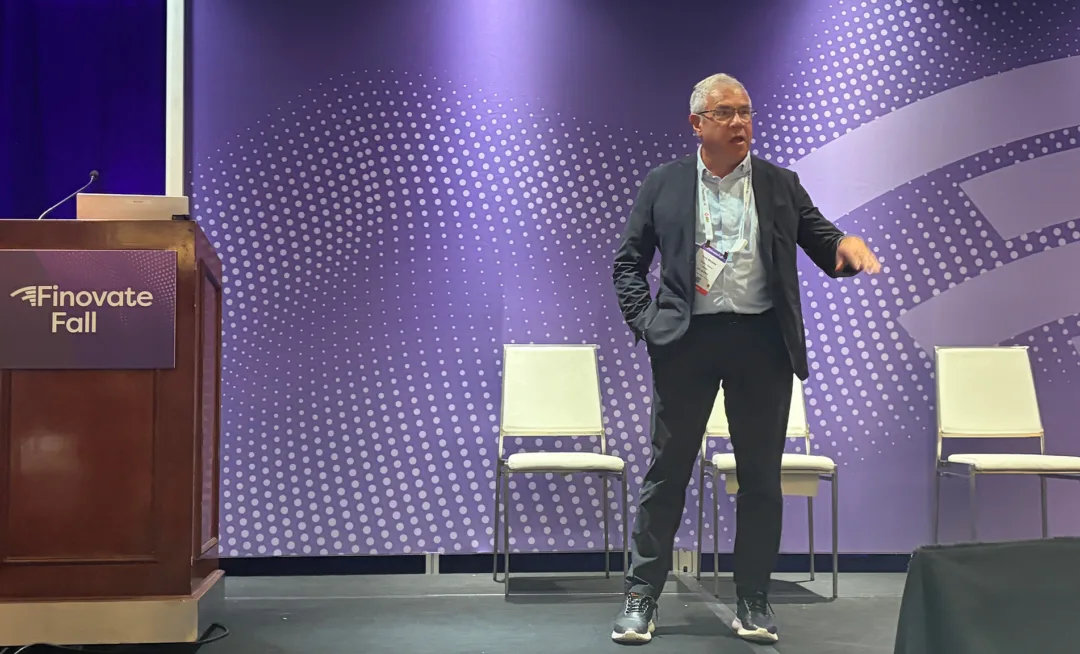
These numbers, presented by Gregory founder and CEO Greg Matusky in his keynote at FinovateFall 2026 in New York, framed one of the most consequential conversations of the conference. The fintech buying journey has moved out of human hands and into a machine layer that runs almost entirely out of sight.
Gregory spent six weeks testing three AI engines, Gemini, ChatGPT and Google Overviews, across nine fintech sectors, from wealth tech to pay tech to crypto. The team ran 142 buyer intention queries designed to mimic how a real buying committee researches a vendor, generated nearly 3,000 answers and reviewed 15,000 citations behind those answers. The finding that mattered most to the room: AI search has reached parity with Google as a research tool, and the evaluation it powers happens without the vendor ever knowing it occurred.
The vetting you'll never see
"There's a CTO at a major institution investigating you," Greg told the room, and most founders have no idea it is happening. A bank in Charlotte or a credit union in Orange County can run a full evaluation of a fintech vendor without a single email, demo request or website visit that shows up in analytics. The evaluation runs silently, and by the time a founder notices interest, the buyer has often already formed a point of view. That point of view is built on far more than a company's own marketing. It draws on association content, trade publications, analyst commentary and news coverage, all synthesized into a single narrative the AI serves back to the buyer.
Five stages, five different battles
Greg broke the fintech buying journey into five stages, and each one rewards a different kind of content. Problem framing comes first, where an institution defines its own need before it ever considers a brand. Category definition follows, where trade associations, consultants and the most trusted names in a sector shape what the buyer believes the category even contains. From there the process moves into comparative search, a head-to-head phase where buyers stack vendors against each other. Credibility comes next, surfacing any litigation, regulatory issue or negative review tied to a brand. Only after clearing all four stages does a vendor reach RFP formulation, the point where pricing and deployment timelines finally matter. A fintech's own content plays a role at every stage, but it stops being the deciding factor well before the finish line.
Comparative content decides who survives the middle
Stage three is where most fintechs disappear, and few ever learn why. Association and consultant influence, so dominant in the early category stage, fades sharply once buyers move into comparative search. What replaces it are comparative listings, whether posted by the vendor itself or compiled by a third party. A fintech that has not built or influenced this kind of content is invisible at the exact moment buyers are deciding who makes the shortlist. Owning that comparison, on your own site or through a third-party provider, is no longer optional positioning. It is table stakes for surviving into the next round.
Credibility is earned by elimination, not perfection
The fourth stage, credibility, produced the keynote's sharpest data point. Matusky cited one fintech, whose own website generated twenty-five percent of the credibility-stage answers in the study, none of it negative. Instead, that content was doing something more valuable: qualifying which of the fintech’s roughly eight hundred bank clients around the world were worth pursuing and which were wasting the top of the funnel. Third-party sites carried the actual red flags, accounting for seventy-six percent of negative signals, sourced from analyst platforms l, software review sites and news coverage. With eight people typically sitting on a buying committee and each one running up to fifteen searches before a vendor even knows they exist, that third-party layer is not a footnote. It is often the deciding factor in whether a company reaches the RFP stage at all.
Buyers want a story, not a database
The keynote's closing point reframed everything that came before it. Google search rewards vendors for being found. AI search rewards vendors for being explainable inside a narrative, because that is how buying committees actually process information. Greg argued that this is the real reason AI search feels so different from a traditional search engine: it does not return a list of links for a human to piece together, it synthesizes competing sources into a single story and hands it to the buyer as if an analyst had written it. Fintechs that treat their content as a checklist of keywords are optimizing for a search engine that buying committees have already stopped using in the way that matters most.
For fintech founders in the room, the takeaway was less about visibility and more about narrative control across five distinct battles rather than one. Winning the discovery stage does nothing if a company has no answer for the comparative stage, and surviving the comparative stage does nothing if credibility signals from third parties go unmanaged. The institutions doing the evaluating are already treating AI as an analyst, not a search bar. Fintechs that keep treating AI search as a single scoreboard will keep losing deals they never knew they were in.